Claude Code Agency & Client Delivery System
Turn Claude Code into your client delivery system. Discover, scope, propose, onboard, build, review, launch, hand off and retain website clients with commands that read one set of files per client — evidence in every audit, counts in every scope, a range in every estimate, and a person between every draft and the client.
One payment. Instant download. Licensed to one person for unlimited clients, including branding the client-facing documents as your own. Not legal or accounting advice.
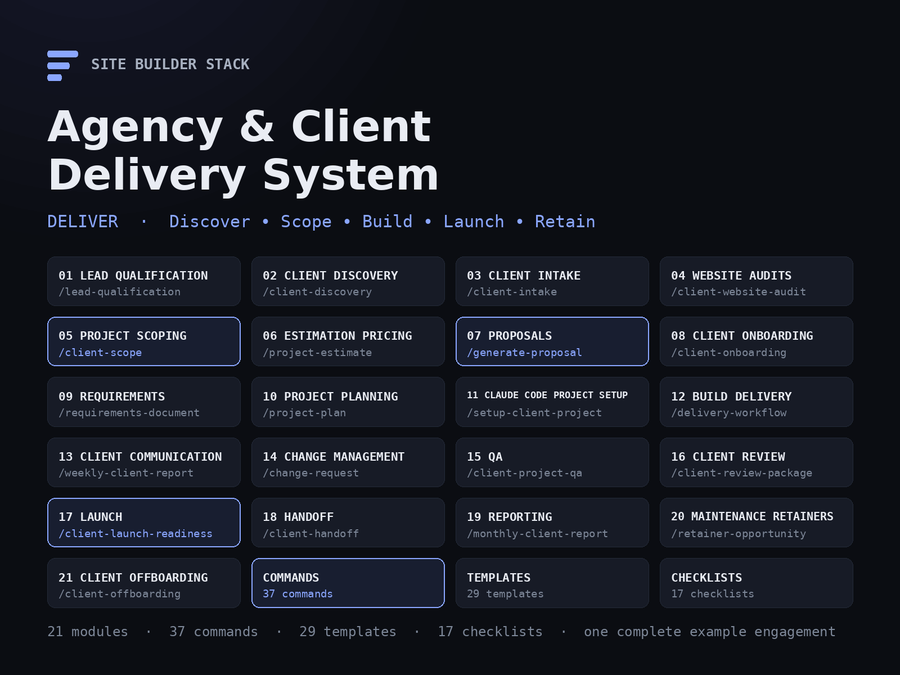
Turn Claude Code Into Your Client Delivery System.
A complete operating system for freelancers and agencies to discover, scope, propose, build, review, launch, hand off and retain website clients — as Claude Code commands that read one set of files per client and write into them, with a person between every draft and the client. Not a folder of proposal prompts: 21 modules, 37 commands, 29 templates plus a client-project skeleton, 17 checklists, 12 report shapes, 3 worksheets, four small scripts, and one complete fictional engagement to read before you run your own.
The problem
Most developers know how to build a website. The engagement around it is where the money and the reputation go: a proposal improvised the night before, a scope that said “and anything else needed”, an estimate that was a guess, revisions that never end because nobody counted the rounds, documentation that lives in a chat thread, a handoff that is a folder of files, and no process for turning a finished project into next month’s income. Each engagement starts from scratch; each one teaches the same lesson again.
Ask a capable model to “write a proposal” and you get the other problem: confident prose with invented requirements, a budget the client never stated, a promise about rankings, and a signature block that looks like a contract. Speed without a system produces professional-looking documents that are not professional.
The solution
A structured delivery system that runs inside Claude Code:
DISCOVER → SCOPE → PROPOSE → ONBOARD → BUILD → REVIEW → LAUNCH → HANDOFF → RETAIN-
One set of files per client —
client-config.yamlfor the facts,CLAUDE.mdfor the rules, the scope as the contract, and four logs (decisions, assumptions, changes, risks) as the memory. Every command reads them; none invents. -
Claude Code commands for every stage, each marked INTERNAL USE or CLIENT-FACING, each with its purpose, inputs, required context, steps, business rules, output format and validation — from
/lead-qualificationto/retainer-opportunity, with/agency-project-statusas the one-block summary of any engagement. -
Scope discipline as a habit: counts in the scope, an out-of-scope list before the price, acceptance criteria you can test, and
/scope-change-checkthat classifies any new request in a minute with the reply drafted — calm, because it is arithmetic. - Evidence over confidence: audits with evidence and a five-level priority system, estimates as ranges with assumptions, readiness with proof, reports where every number names its source and missing data says unavailable.
- The ten operating rules in every command: work within scope, never invent client facts, identify uncertainty, preserve what works, expose no credentials, document changes, validate before done, flag scope creep, promise nothing the evidence does not support, stay professional.
What is included
201 files, 21 modules, 37 commands, 29 templates, 17 checklists, 12 report templates, 3 worksheets, 4 scripts — about 56,000 words. Every number here was counted from the bundle at build time.
| Module | Covers |
|---|---|
01-lead-qualification |
Fit score with reasons; the unknowns; the questions before unpaid discovery |
02-client-discovery |
Six areas — business, website, conversion, content, SEO, technical; the report the client confirms |
03-client-intake |
Assets and access with dates; the access inventory that holds no credentials by design |
04-website-audits |
Technical, SEO and conversion audits; issue, evidence, impact, recommendation, effort, priority |
05-project-scoping |
The scope document; counts; out-of-scope; acceptance; the scope check |
06-estimation-pricing |
Low / expected / high with assumptions; the price arithmetic; seven pricing models |
07-proposals |
Six proposal shapes; what a proposal must never do; Markdown to PDF without proprietary tools |
08-client-onboarding |
One approver, one channel, the kickoff agenda, the day-for-day rule said out loud |
09-requirements |
Twelve sections with a source per requirement; TBD as a value; traceability |
10-project-planning |
Phases, milestones as acceptance points, client inputs with dates, the risk register |
11-claude-code-project-setup |
The workspace and the context Claude Code reads; never overwrites |
12-build-delivery |
Requirements → plan → implement → self-review → test → document → review; the definition of done |
13-client-communication |
Status, questions, delays, review and approval requests in three registers; the weekly report |
14-change-management |
Classify, four impacts, approve, log — not every change costs money; every change is recorded |
15-qa |
Seven areas; PASS / PASS WITH ISSUES / FAIL; launch blockers named |
16-client-review |
Bounded rounds; the package; feedback triage into six classes |
17-launch |
Readiness with evidence — GO / GO WITH WARNINGS / NO-GO; the launch report |
18-handoff |
The plain-language document; access transferred, yours removed |
19-reporting |
Monthly reports where every number has a source and missing data says so |
20-maintenance-retainers |
Services from evidence; the retainer builder; response targets that are not guarantees |
21-client-offboarding |
The clean ending; the retrospective that edits the system; honest testimonials only |
Plus .claude/commands/ with 37 slash commands, templates/ with 29 templates and the client-project skeleton, 17 checklists, 12 report templates, 3 worksheets, a reference set (project-type overlays for ten kinds of project, Shopify / WordPress / static workflows, pricing reasoning with hypothetical examples, the client data policy, the communication rules, twelve troubleshooting entries), four standard-library scripts, and examples/example-client-project/ — a fictional physiotherapy clinic’s redesign from enquiry to retainer, every file.
The commands
| Command | Audience | Purpose |
|---|---|---|
/lead-qualification · /client-discovery · /client-intake
|
Internal → client | Fit score; the six-area discovery report; assets and access with secure methods |
/technical-audit · /seo-audit · /conversion-audit · /client-website-audit
|
Internal → client | Evidence-based findings; the combined report with an executive summary |
/client-scope · /scope-change-check
|
Internal → client | The scope document; IN SCOPE / AMBIGUOUS / OUT OF SCOPE for any request |
/project-estimate · /generate-proposal
|
Internal / client | A range with assumptions; one of six proposal templates filled from the files |
/client-onboarding · /setup-client-project · /requirements-document · /project-plan
|
Mixed | The start: approver, channel, kickoff, workspace, requirements with sources, the plan |
/delivery-workflow · /client-project-qa
|
Internal | The build loop against the definition of done; seven-area QA with blockers |
/client-status-update · /weekly-client-report · /client-question · /client-delay-notice · /client-review-request · /client-approval-request · /client-meeting-summary
|
Client-facing drafts | Professional, concise, no blame, no promises; nothing sent automatically |
/change-request · /client-feedback-triage · /client-review-package
|
Mixed | Four impacts and approval; six feedback classes; bounded review rounds |
/client-launch-readiness · /client-launch-report · /client-handoff
|
Mixed | GO / GO WITH WARNINGS / NO-GO with evidence; the record; the plain-language handoff |
/monthly-client-report · /retainer-opportunity
|
Client-facing | Sourced numbers; services the site needs, with evidence |
/client-offboarding · /project-retrospective · /project-estimate-review · /case-study-draft
|
Mixed | The clean ending; the lessons as edits; estimate vs actual; a draft from facts only |
/agency-project-status |
Internal |
The master summary. Phase, status, every stage, blockers, client actions, risks, next five actions; project-status.json
|
Use cases
- Turn discovery notes into a professional scope with counts, an out-of-scope list and acceptance criteria.
- Generate a proposal from a technical audit — findings become priority actions, priority actions become scope.
- Detect whether a new request is scope creep, and reply in a minute without an argument.
- Create client status reports in minutes from the tracker, with the client’s actions and dates in their own section.
- Build a repeatable QA process that runs before every client review and again before launch.
- Create a professional client handoff in plain language, with every access transferred and none of yours left behind.
- Turn completed projects into legitimate maintenance retainers built from what the site actually needs.
- Standardise delivery across every client project, and improve it with each retrospective.
Who it is for
Freelance web developers; small web agencies; DevOps and technical consultants; Shopify developers; WordPress developers; AI-first agencies; solo technical founders; developers entering consulting. It assumes you can build the site. It does not assume you have run a client engagement before — the modules are written for a first one, and the example is a whole engagement you can read end to end.
Safety and honesty
No credentials in any file, ever: access is granted by platform invitation and recorded as present or missing. No invented client facts, budgets or metrics: TBD is a value, and a report says unavailable rather than guessing. No promised rankings, conversion increases, revenue, or launch dates while an input is outstanding. Nothing is sent to a client by a command; a person reads and sends. Testimonials are asked for honestly and never written for the client; case studies use only the facts in the files.
And plainly: this is not legal, accounting or tax advice. Proposals are not contracts, scope documents do not replace agreements, retainer templates describe services rather than terms, and the pricing examples are hypothetical reasoning, not rates.
How it fits with the other six
This is the engagement layer. The other products are the technical layers it sells and delivers with, and each is separate — buying one includes none of the others.
| With | Price | The engagement it makes deliverable |
|---|---|---|
| Website Launch System | $19.99 | Building client websites — the build inside the delivery workflow |
| SEO & Website Audit Toolkit | $19.99 | SEO audit engagements — the deep audit behind the audit-and-build proposal |
| Conversion & Revenue Optimization Toolkit | $19.99 | Conversion optimisation engagements |
| Operations & Maintenance System | $39.99 | Monthly maintenance retainers — the delivery side of the retainer you design here |
| Website Migration & Replatforming System | $29.99 | Migration projects — the technical work behind the migration project type |
| Shopify Automation & Admin API Toolkit | $39.99 | Ongoing Shopify catalogue operations as a retainer |
The first three are also sold together as the Complete Site Builder Stack. This product is not in any bundle; there is no automatic upgrade credit.
Delivery and licence
A single ZIP, delivered by download immediately after purchase. 201 files, about 240 KB — Markdown, CSV, YAML, JSON and four small Python scripts; nothing to install beyond Python 3, which your machine almost certainly has. A published SHA-256 checksum accompanies the download so you can verify what you received.
Licensed to one person for unlimited clients, including branding the client-facing documents as your own. You may not redistribute or resell it, or sell the templates as a competing product. Full terms are in LICENSE.md inside the archive.
What is not promised
No client, no signature, no renewal, no profit. The system makes each engagement clearer, more repeatable and better documented; whether a prospect says yes, what you charge, and how the project goes are yours — and it is built so that they stay yours and are written down.
Inside the Agency & Client Delivery System
No video is published yet. Below is the same walkthrough it will narrate, in a form that works today.
-
What lands in your inbox
One ZIP. Twenty-one numbered modules, 37 slash commands, 29 templates plus a client-project skeleton, 17 checklists, 12 report shapes, 3 worksheets, a reference set, four small scripts and a complete fictional engagement — about 56,000 words. Markdown, CSV, YAML; Python 3 standard library for the scripts.
claude-code-agency-client-delivery-system/ START-HERE.md QUICK-START.md 01-lead-qualification/ 02-client-discovery/ ... 21-client-offboarding/ .claude/commands/ templates/ (incl. client-project/) checklists/ reports/ worksheets/ reference/ scripts/ examples/example-client-project/ -
The first ten minutes
Copy the commands, scripts and templates into your agency folder; create the client project with the script (it never overwrites); fill the config from what you know; run discovery.
cp .claude/commands/*.md your-agency/.claude/commands/ cp -r scripts templates your-agency/ cd your-agency python3 scripts/new_client.py "Northwind Supply" --project "Website Redesign" --platform wordpress --type redesign created clients/northwind-supply (28 files). Next: fill client-config.yaml, then /lead-qualification or /client-discovery cd clients/northwind-supply && claude > /client-discovery -
Qualify before you spend unpaid hours
The intake is quoted, not paraphrased; a budget the prospect did not state stays blank. The score comes with reasons, the unknowns become the next call's questions, and WEAK means "not on these terms", not "no".
LEAD QUALIFICATION Client: Harbourline Physio (director) Project: Website redesign, WordPress, same domain FIT SCORE: STRONG Project Type: Redesign; SEO preservation; booking conversion Estimated Complexity: M Unknowns: - Which pages carry the organic traffic (Search Console) - Who holds hosting and registrar access Recommended Next Step: Book discovery; request Search Console/GA4 access first. -
Audit with evidence, then scope from it
Every finding has an issue, evidence, business impact, recommendation, effort and a priority from CRITICAL to OPPORTUNITY. The priority actions become the candidate scope; the executive summary is two pages the client reads.
## Priority actions | # | Action | Priority | Effort | | 1 | Booking CTA on every page; widget above fold | HIGH | build | | 2 | Preserve the two URLs with 61% of clicks | HIGH | S | | 3 | Rebuild templates for mobile (LCP 5.8 s) | HIGH | M | | 4 | Unique titles; merge 4 thin pages with 301s | HIGH | S | Not checked: server logs; the booking widget's own analytics. -
A scope with counts and an out-of-scope list
In scope is counted (pages, templates, rounds, forms). Out of scope names what the client will think of later. Client responsibilities carry dates and the day-for-day rule. Every deliverable has a criterion someone can test.
IN SCOPE 3. Design for the five page templates, desktop and mobile, 2 revision rounds 4. Build as a child theme: 11 pages plus the profile template OUT OF SCOPE 1. Copywriting beyond light drafts of titles/descriptions 4. Online payments, deposits, or a client portal 9. Maintenance beyond the 30-day defect window CLIENT RESPONSIBILITIES - Final copy for all 11 pages by 30 Oct; each business day late moves launch by one business day -
An estimate that is a range
Work items with low, expected and high hours and a note per row saying what each assumes. The script totals by phase, applies contingency as a line, and prints the assumptions. The proposal quotes the range or the high — never the low alone.
$ python3 scripts/estimate.py project-estimation.csv --contingency 15 --rate 90 PROJECT ESTIMATE — 18 work item(s) phase low expected high Design 29.5 33.0 49.5 Development 30.0 34.5 50.0 ... TOTAL 95.5 135.8 205.2 hours before contingency 95.5 156.1 236.0 with 15% contingency at 90.00/hour: 8595 14050 21243 ASSUMPTIONS (from the worksheet notes): - Page assembly: 11 pages; assumes copy on time -
Scope creep, classified in a minute
Every new request is checked against the scope text — quoted, not remembered — and classified IN SCOPE, AMBIGUOUS or OUT OF SCOPE with the four impacts and the reply drafted. Not every change costs money; every change is logged.
REQUEST: "Could clients pay for the assessment when they book?" ORIGINAL SCOPE: out-of-scope item 4 "Online payments, deposits, or a patient/client portal" CLASSIFICATION: OUT OF SCOPE ESTIMATED IMPACT: +10 to +15 business days before launch; vendor add-on (client's) + 8–14h configuration; none if phase 2 RECOMMENDED RESPONSE: /change-request CR-02; recommend phase 2 so the 9 December date holds. -
The Friday report, from the tracker
Overall status with the one-sentence reason; completed, in progress, next week; the client's actions in their own section with dates and consequences; risks; decisions needed; the launch date and why it moved. Ten minutes from the files.
PROJECT STATUS — week of 2 November Overall Status: AT RISK — copy for three service pages is outstanding since 30 October Client Actions Needed: Approve design round 2 Fri 6 Nov build starts Monday Copy for the three service pages Fri 7 Nov launch 9 Dec holds Launch target: 4 December → 9 December if the copy arrives by 7 November (day-for-day rule). -
Launch on evidence
Thirteen checks with the file, the log entry or the test that proves each: scope, requirements, QA on the production build, written approval, backup, DNS, SSL, redirects, SEO, analytics, forms, environment, rollback. Any blocker is NO-GO regardless of the date.
LAUNCH RECOMMENDATION: GO WITH WARNINGS Decided by RL (recommendation) and the director (approval 8 Dec 16:20) | Client approval | PASS | decision-log 2026-12-03; 8 Dec email | | Backup | PASS | host 8 Dec 09:00; restore tested 2 Dec | | Redirects | WARN | 4 rules staged; verified at T+15m | | Rollback plan | PASS | previous theme kept; 15 minutes; RL | Blockers: none -
The whole engagement in one block
From the config, the tracker, the action items, the risks and the change log: phase, status, every stage, blockers, client actions, risks, the next five actions — and project-status.json for whatever you build on top.
$ python3 scripts/project_status.py --dir clients/harbourline
CLIENT PROJECT STATUS
Client:   Harbourline Physio
Project:  Website Redesign
Current Phase:   build
Overall Status:  BLOCKED

BLOCKERS:
1. Copy for 11 pages (Content) is blocked on the client: 8 of 11 received

CLIENT ACTIONS REQUIRED:
1. Copy for Sports; Post-surgical; Workplace pages (due 2026-10-30) — overdue by 7 day(s)
2. Approve design round 2 (due 2026-11-06)

wrote project-status.json
The recorded walkthrough is not published yet. Rather than put a play button over a still image, the steps above are the same tour in writing — the real folder names, the real commands, and real output from the example engagement inside the download.
The example client is fictional; its status and estimate outputs are reproduced by running the scripts on its files.
Before you buy
The questions people ask about a delivery system for client work, answered plainly.
No. It is one set of files per client that every command reads and writes — the config, the scope, four logs — with 37 commands that turn them into discovery reports, audits, scopes, estimates, proposals, plans, QA reports, review packages, readiness decisions, handoffs, monthly reports and retainer recommendations. The proposal templates are six of 29 templates, and each is filled from the scope and the estimate rather than from thin air.
Never. Every command that produces client-facing text produces a draft, marked as such, for a person to read, edit and send. The communication rules it follows — concise, factual, no blame, no promises the evidence does not support, client actions with dates — are in the reference set and in every command.
No, and no. Proposals describe the work and the price and say so in their last line; scope documents do not replace an agreement; the retainer templates describe services, not terms; the pricing guidance is reasoning with hypothetical figures, not rates or accounting advice. Use your own agreements and your own advisers for the legal and financial side.
Claude Code, Python 3.8 or newer for the four small scripts (standard library only), and a client. It assumes you can build the website; it does not assume you have run an engagement before — the modules are written for a first one and the example is a whole engagement to read.
It does not hold them. Access is granted by each platform's own invitation — collaborator, user, editor — per person, least privilege, removed at offboarding. The access inventory records that access exists or is missing, never a value. The client data policy, the .gitignore template and the validation script enforce it; a credential-shaped string in a project file fails validation.
No. A requirement has a source — discovery notes, an email, a meeting date — or it is marked TBD with a question and an owner. A budget appears only if the prospect stated one, quoted. A report's number has a source or it says unavailable. Those are operating rules in CLAUDE.md and in every command's business rules.
The engagement is platform-neutral; the reference set has workflows for Shopify (collaborator access, unpublished themes, apps, checkout limits, the test order), WordPress (admin per person, staging, plugins, backups, updates) and static/Astro (repository, preview deploys, forms, CI) — and overlays for ten project types from a landing page to a migration to a maintenance engagement.
This is the engagement layer; the others are the technical layers it sells and delivers with — the Launch System to build, the SEO and Conversion toolkits for audit engagements, the Operations system to deliver maintenance retainers, the Migration system for migration projects, the Shopify toolkit for catalogue retainers. Each is separate; none is required; the modules say "if you own it" where one would help.
A fictional physiotherapy clinic's website redesign from the enquiry form to the retainer recommendation: intake, qualification, discovery, audit and executive summary, scope, estimate (two options), proposal, onboarding, kickoff summary, access inventory, requirements and traceability, plan, tracker, risk register, scope checks, a change request, a weekly report, QA, a review package and triage, launch readiness and report, handoff, retainer recommendation, estimate review and retrospective. The CSVs are real script input; the status and estimate outputs are reproduced by running the scripts on them.
Yes: one person, unlimited clients, no expiry, and the client-facing documents you produce may carry your name and brand. You may not resell or redistribute the system, or sell its templates as a competing product.
This is the engagement; these are the tools it delivers with
The delivery system sells and runs the engagement. Building, ranking, converting, operating, migrating and automating Shopify are the six technical products it pairs with — each separate, none required.
-
Build & launch
The Claude Code Website Launch System
Platform build systems, a production CLAUDE.md, security and accessibility audits, 100 prompts and launch checklists — the build inside your delivery workflow.
$19.99
-
Get found
Claude Code SEO & Website Audit Toolkit
Crawlability, indexation, structured data, Core Web Vitals and Search Console — the deep audit behind an SEO engagement.
$19.99
-
Convert
Claude Code Conversion & Revenue Optimization Toolkit
70 workflows and 68 commands for finding where a client's site loses conversions — the conversion optimisation engagement.
$19.99
-
Operate & maintain
Claude Code Website Operations & Maintenance System
Uptime, security, backups, deploys, incidents and monthly reporting — the delivery side of the maintenance retainer you design here.
$39.99
-
Migrate
Claude Code Website Migration & Replatforming System
Inventory, map, redirects, comparison, DNS recorded, GO / NO-GO — the technical work behind a migration project.
$29.99
-
Automate Shopify
Claude Code Shopify Automation & Admin API Toolkit
Products, collections, SEO, metafields and bulk operations through the Admin GraphQL API — a Shopify catalogue retainer's delivery side.
$39.99
-
Build, rank, convert
Complete Site Builder Stack
The first three systems together on one order — the same three products at the same versions, for less than buying them separately.
$39.99
Each solves a different stage. The whole lifecycle is explained here if you are not sure which you are in.
Selling maintenance retainers?
The Claude Code Website Operations & Maintenance System is the delivery side of the retainer this system designs — scheduled checks, standard-library scripts, and a monthly health report your client can read in five minutes.
A separate product. Buying this does not include it, and there is no automatic upgrade credit.